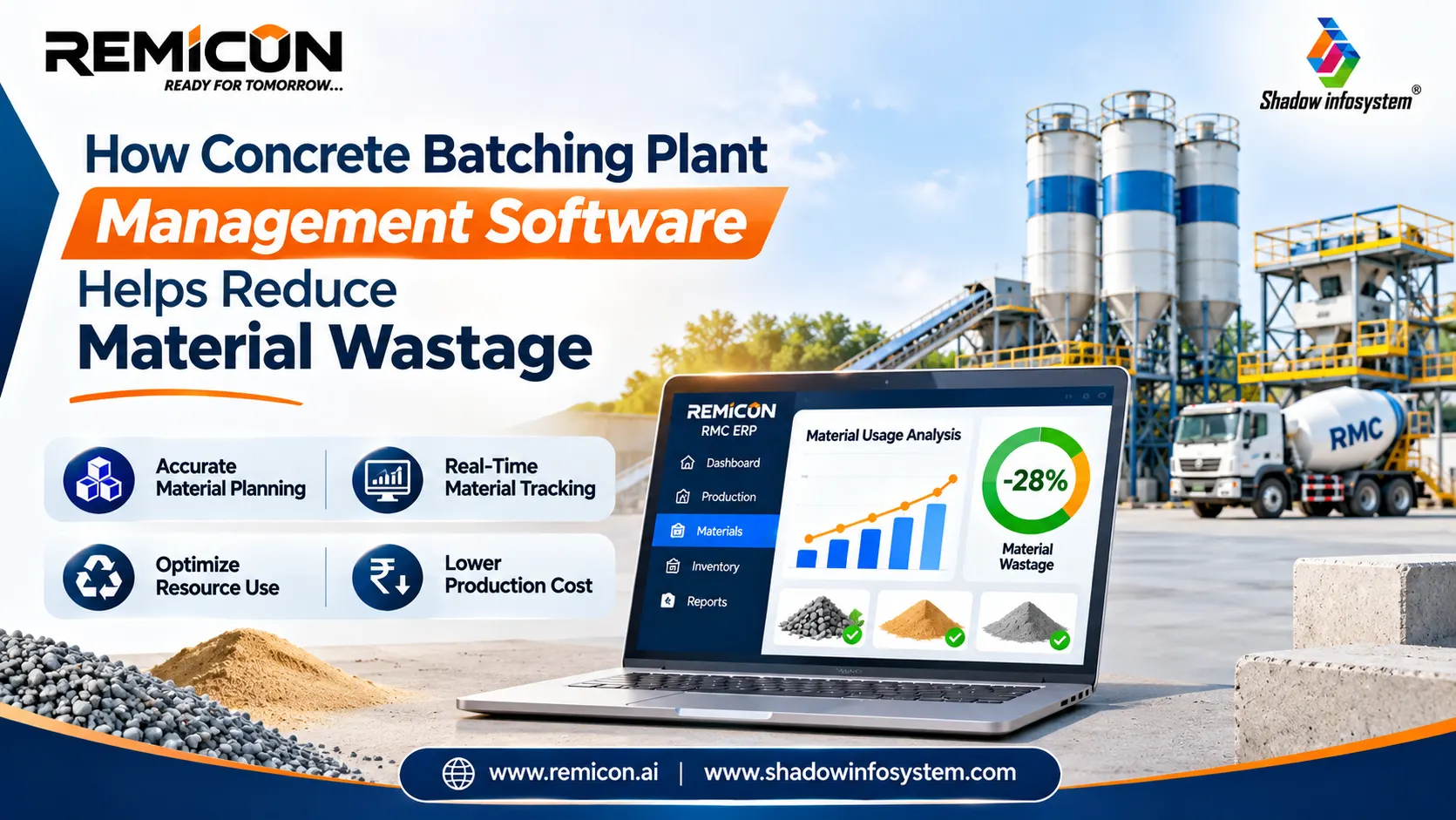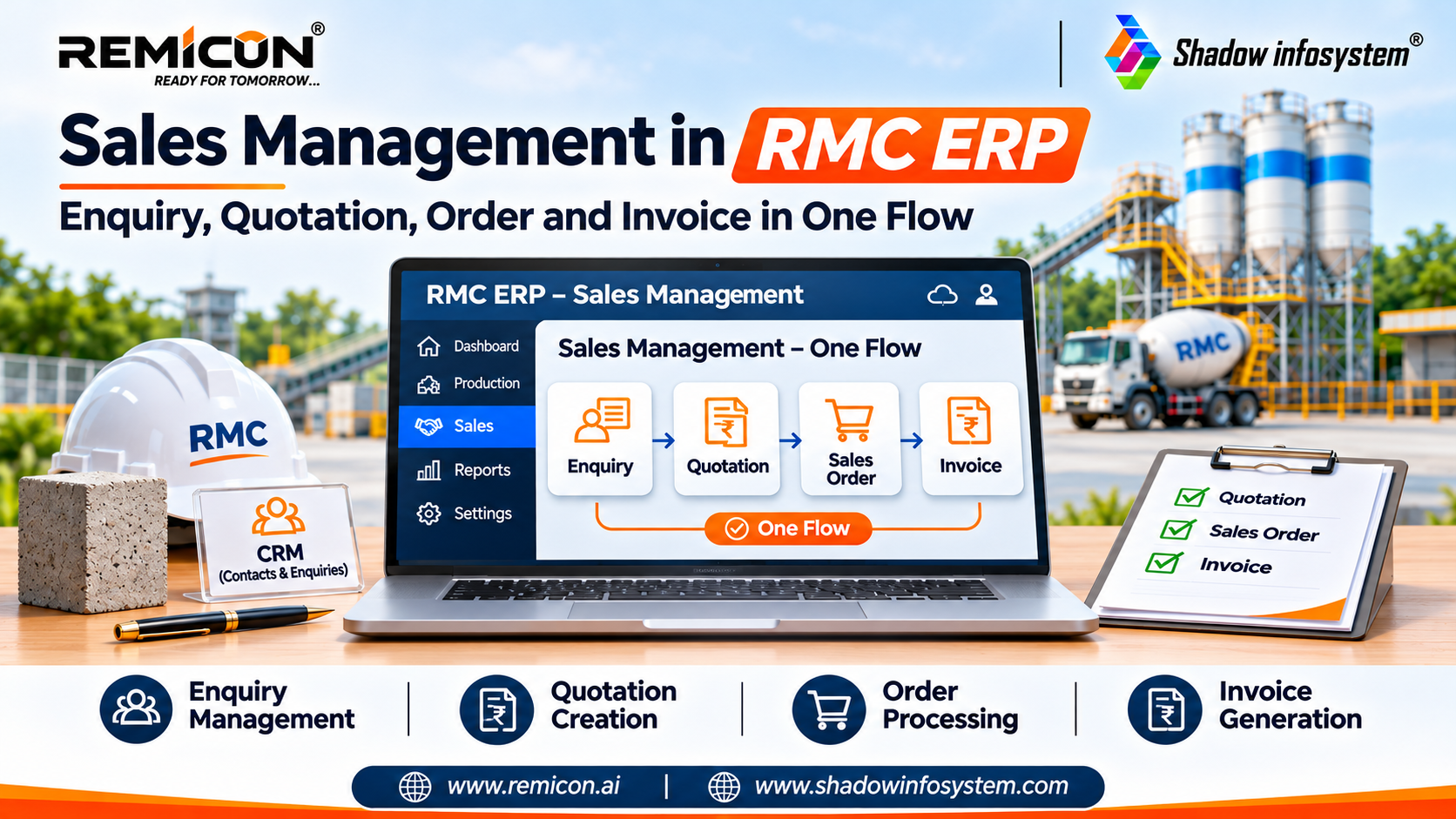

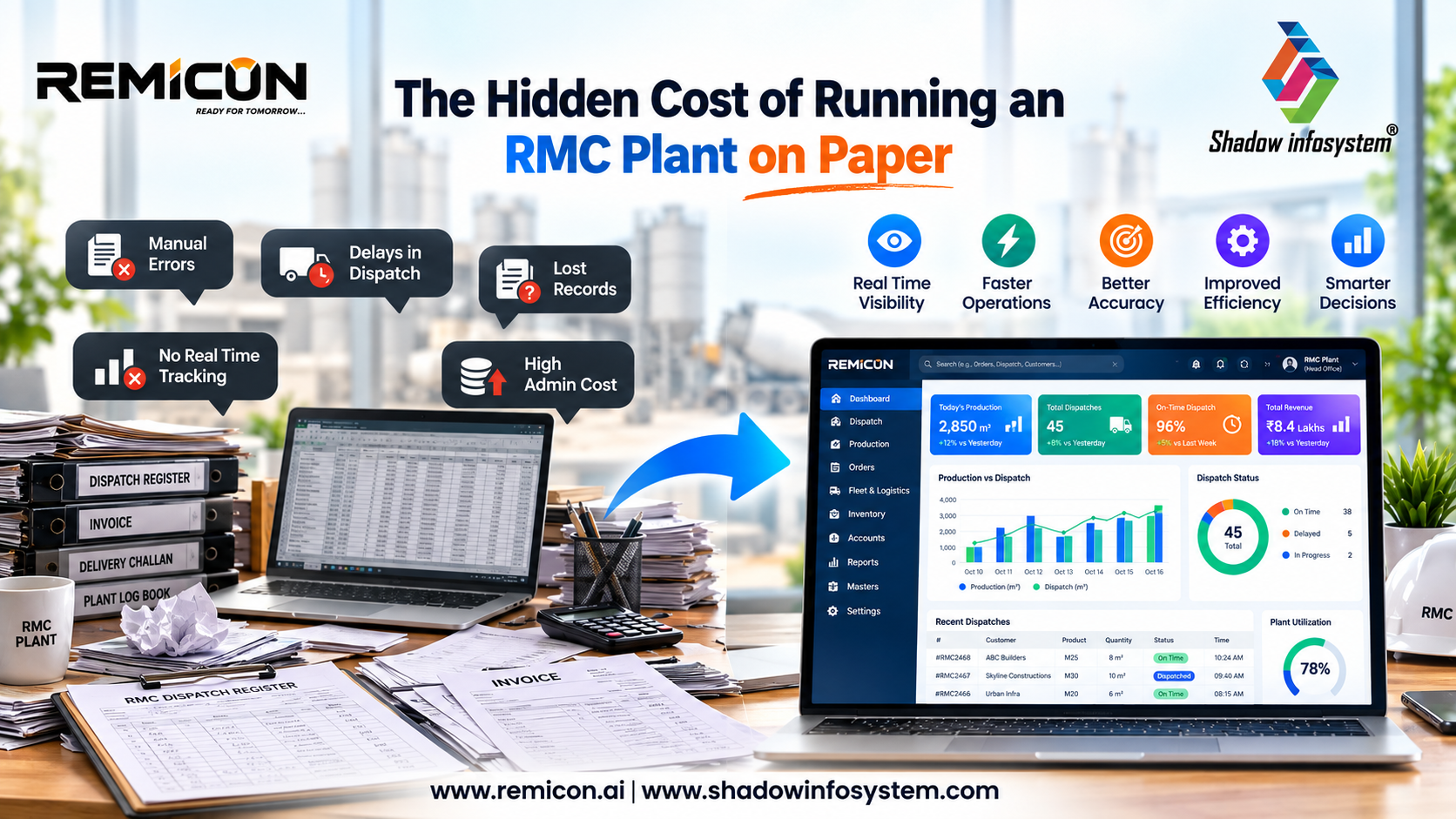
An RMC plant running on paper registers and disconnected Excel sheets can lose money without realizing where it goes. The problem is not always low sales or rising material prices. Often, the loss remains hidden in incomplete records that fail to connect production, dispatch and accounts. Three major leakage points are material consumption that cannot be verified, delivered concrete that never reaches the invoice, and customer payments that arrive late because billing is delayed. RMC plant management software helps connect these activities, giving plant owners better visibility into actual consumption, dispatch quantities and outstanding payments before small gaps become recurring financial problems.
Why Paper Records Feel Like They Are Working
Paper-based records are conventional, easily manageable, and entail minimal cost at the beginning. The production supervisor keeps the record of the material utilization, the dispatching section prepares the challan, the storekeeper maintains the stock ledger, and the accounts section prepares the invoice. Everything seems to be on track.
The mere fact of keeping records does not assure us about the completeness and consistency of the data.
The production ledger may indicate the amount of concrete produced but will not explain the variance between the theoretical and actual material utilization. The dispatch ledger may hold the data regarding deliveries, while the billing department maintains its records based on challans. Likewise, the accounts department can have data about the pending payments but cannot verify the completeness of the delivery records.
All these incomplete records leave many loopholes that go unnoticed during normal operations. The employees find themselves busy with verifying and matching the entries rather than finding out the cause behind the errors.
Leak 1: Material You Paid For and Cannot Account For
Cement, aggregates, sand, and additives are major components of an RMC plant's operational cost. Minor variances in consumption can be quite costly when performed in hundreds of batches.
Each approved mix design provides the theoretical amount of material needed to produce a specific volume of concrete. Comparing these theoretical amounts with the actual consumption of material can reveal unexpected variances.
A paper log may include the amount of cement issued and produced during one shift but may not compute variance per batch and also does not take into consideration the stock variance.
Think of a plant that constantly uses more cement than the recommended mix design specifies. In the absence of batching comparisons, the management may only identify the difference during a physical stock count. By this time, it will be hard to pinpoint the offending batch or shift.
Other reasons could be measurement errors, erroneous data entry, stock transfer, or material waste. On its own, the difference does not indicate material misuse, but points to an issue that should be investigated.
Reconciliation of planned consumption against batching and stock movement records can enable plant owners to investigate such differences sooner.
Leak 2: Concrete You Delivered but Never Billed
The mere process of concrete production and delivery cannot ensure full billing. There is a possibility that revenue will go unaccounted for due to the creation of dispatch books and invoices in separate manners.
For instance, a customer could be made to receive more than one delivery in the same order. All the trips would be recorded in the challan book, but the accounts department gets only some of the delivery challans. Another factor that could have been missed out could be another trip, any change in quantity, or the pumping charges, if any.
Other factors like waiting time, returning trips, and partial deliveries would also come into play based on the commercial terms agreed upon with the customer.
This problem becomes even more possible where dispatchers give physical challans at the end of the day or where there are many people maintaining records. It should also flag missing documents, quantities awaiting confirmation and charges requiring review.
This does not mean every difference is automatically billable. Contract terms, customer approvals and actual delivery evidence must determine the final invoice.
The objective is to ensure that every completed delivery is accounted for, every discrepancy is investigated, and every eligible charge reaches the billing team.
Leak 3: Money Sitting With Customers for Too Long
Even when the clients are ready to pay on time, delayed invoicing influences cash flow.
If a concrete delivery is made today but invoiced ten days later because the accounts department is busy preparing challans and confirming quantities, then the payment process is initiated at a later stage.
Repeat this process for many customers and frequent deliveries, and it becomes evident that a concrete plant may be holding many receivables even though sales are good.
It also makes it more difficult to determine who amongst the clients has their dues pending, which invoices are waiting for support and which payments require urgent action.
Efficient billing process helps to save a lot of time when it comes to gathering the dispatch information for generating invoices. The receivables report will assist in prioritising the follow-ups according to the amount that is due and its due date.
GST invoice accuracy, payments and reconciliations of the customer’s account continue to be extremely important. Visibility makes it easier to do so but does not take care of customer approval and payment.
The value here lies in the ability to act on receivables by saving administrative effort.
Leak 4: Diesel and Trips Nobody Can Verify
Fleet expenses can become difficult to control when transit mixer trips, vehicle movements and diesel issue slips are maintained independently.
A manual diesel register might record the quantity issued to a vehicle without connecting it to the distance travelled, number of trips or concrete delivered. Similarly, a trip register may show dispatch activity without confirming the corresponding fuel usage.
Without these connections, management cannot easily distinguish normal operational variation from entries that need investigation.
A more reliable process connects vehicle identification, trip details, dispatch records and fuel transactions. Where supported integrations are available, existing GPS tracking systems can provide additional vehicle movement information.
Plant managers can then review indicators such as:
Diesel issued against individual vehicles.
Trips completed against dispatch schedules.
Delivery quantities associated with each trip.
Unusual fuel consumption patterns requiring verification.
Delays and repeated trips that affect operating costs.
These indicators help identify questions that paper records may leave unanswered. They should be interpreted alongside vehicle condition, traffic, route distance, load size and operating conditions rather than treated as automatic proof of wastage.
Leak 5: Quality Records That Cannot Be Traced
Quality documentation becomes particularly important when a customer raises a concern about concrete strength or a project requires supporting test records.
Cube samples are tested at specified ages, commonly including 7 and 28 days, according to the applicable testing requirements. By the time a 28-day result becomes available, the original production and delivery details may be difficult to retrieve from separate registers.
A useful quality record should connect the relevant sample and test results with the concrete grade, mix design, production batch, delivery challan and project details.
When this information is scattered across laboratory sheets, production registers and dispatch files, investigating a complaint takes longer. Missing links can also make it difficult to establish which records relate to the concrete in question.
A traceable record system helps authorised personnel retrieve the relevant information without searching through multiple files. It also supports internal quality reviews, documentation checks and customer discussions.
Digital records cannot correct poor sampling, improper testing or inaccurate entries. Their value lies in preserving the connection between production information and quality evidence so that investigations can be conducted using the available records.
What Changes When Records Move Into a System
Moving from registers to ready mix concrete batch software changes how information flows through the plant. Instead of maintaining isolated entries, teams can work with connected records that follow production and delivery activities.
A batch can be associated with its mix design, actual material consumption, production time, dispatch details and relevant quality records. When the supporting modules are connected, the same batch identity helps authorised users trace information across departments.
Concrete batching plant software can also reduce repeated data entry when production controllers and other systems provide compatible data.
The practical benefits include:
Batch-level material visibility: Compare expected and recorded consumption to identify discrepancies for investigation.
Connected dispatch records: Link delivery challans with orders, vehicles and delivered quantities.
Faster billing preparation: Give accounts teams access to verified dispatch information without waiting for multiple registers to be collected.
Inventory reconciliation: Compare stock movements, material receipts and consumption records.
Quality traceability: Retrieve available batch, delivery and test information using consistent identifiers.
Management reporting: Review production, material usage, dispatch activity, billing and receivables through structured reports.
A digital system does not eliminate every error automatically. Its effectiveness depends on accurate entries, suitable integrations, defined responsibilities and consistent usage.
The objective is to reduce the time between an operational event and management's ability to understand it. When a discrepancy occurs, the team should be able to identify where it happened, review the supporting information and take corrective action.
What RMC Plant Management Software Should Actually Cover
A useful system should connect the plant's main operational and financial activities rather than simply replace handwritten registers with digital forms. When evaluating concrete batching plant ERP software, examine the following capabilities.
Production and batching: Maintain production records, approved mix designs, batch quantities and available controller data.
Inventory and silo management: Record material receipts, stock movements, consumption and closing balances to support reconciliation.
Dispatch and challans: Connect customer orders, delivery challans, trip information and delivered quantities.
Transit mixer tracking: Maintain vehicle and trip records, with integration options for existing tracking systems where supported.
Diesel and fleet management: Record fuel issues, vehicle expenses and relevant trip information for operational review.
Quality management: Maintain traceable mix, sample and test records with links to relevant production and delivery details.
GST billing and accounts: Support invoice preparation, GST documentation, receivables, payables, expenses and payment tracking.
MIS reports and multi-plant visibility: Help management compare operational and financial performance across shifts, departments and plants.
Before selecting a system, confirm which capabilities are available in the proposed package and which require configuration or third-party integration. Relevant internal pages covering production, inventory, dispatch, fleet management, quality and billing should explain each module in greater detail.
How to Compare Options Before You Buy
Choosing the best RMC ERP software requires more than comparing prices or counting features. The system must fit the plant's operating processes and provide dependable information across departments.
Use this checklist during product demonstrations:
Batching controller integration: Can the system receive supported production data from the plant's existing controller?
Weighbridge synchronisation: Can weighment information be linked with the relevant material or delivery transaction?
Multi-plant management: Can authorised users view the required information across multiple locations?
Mobile access: Can users access relevant records through supported mobile devices and internet connectivity?
GST e-invoicing: Does the proposed configuration support the applicable invoicing requirements for the business?
Implementation timeline: What data migration, configuration, testing and training activities are included?
Support arrangements: What are the support hours, escalation process and responsibilities after go-live?
Data security: Are role-based access, backups and appropriate data protection measures available?
Reporting and traceability: Can a single batch be traced from production to delivery, billing and available quality records?
When comparing the best concrete batching plant software options, request a demonstration using a realistic plant scenario rather than a generic presentation. Ask the provider to show how a production record becomes a dispatch entry, how the delivery is billed and how the relevant transaction can be retrieved later.
Also clarify integration costs, data ownership, customisation requirements and ongoing charges before signing an agreement.
Start by Measuring What You Cannot See Today
Before investing in a new system, conduct a simple exercise using records from the previous month.
Select one completed batch and try to assemble its complete record, including the approved mix design, material consumption, production details, dispatch challan, invoice and available quality results.
Record how long it takes to find each document. Note any missing entries, conflicting quantities, repeated calculations or approvals that require manual follow-up.
Next, compare the planned and recorded material consumption, verify the delivered quantity against the invoice, and check whether the relevant customer payment has been received or remains outstanding.
Repeat the exercise for a few batches from different shifts or customers. This will help distinguish isolated documentation errors from recurring process gaps.
The time spent searching is only one part of the cost. The more important questions are whether any material discrepancies remain unexplained, whether eligible deliveries are awaiting billing and whether delayed documentation is affecting collections.
The actual cost of paper records is not the number of registers maintained. It is the financial and operational impact of information that cannot be connected, verified or acted upon in time.
From Paper Records to Better RMC Plant Management
Identifying gaps in material consumption, dispatch, billing and collections is the first step towards controlling the hidden costs of paper-based operations. The next step is to establish a reliable way to maintain and verify business records without repeatedly matching entries across separate registers and spreadsheets. A connected digital system can help RMC plant owners identify discrepancies, access consistent information and make informed operational decisions.
Shadow infosystem, a leading IT company in Noida with over 17 years of successful industry experience, developed an AI-based ERP Software, REMICON, to address the record-keeping and operational challenges faced by ready-mix concrete businesses. Backed by a team of technology experts, the company combines industry knowledge with technical expertise to develop solutions aligned with business requirements.
How REMICON Helps Address the Hidden Costs of Paper Records
REMICON by Shadow infosystem is a cloud-based, AI-enabled ERP solution designed for ready-mix concrete businesses. It brings essential plant operations and business information into a common system, helping businesses improve coordination between departments and maintain consistent records.
Its capabilities include:
Production and batching records connected with plant operations.
Inventory and procurement management for monitoring stock and material movements.
Dispatch, challan and fleet records for delivery tracking and verification.
Billing and financial management, including GST invoices, receivables, payables, expenses and MIS reports.
Quality documentation linked to relevant production and delivery information.
Multi-plant visibility and role-based access for authorised users.
API-based integration with compatible third-party applications and systems.
By connecting operational and financial information, REMICON helps businesses reduce dependence on scattered records and retrieve relevant details when reviewing discrepancies, preparing invoices or monitoring outstanding payments.
Connecting Existing Systems with REMICON
RMC plants may already rely on separate applications for vehicle tracking, communication, accounting and weighing operations. REMICON supports integration with compatible existing systems, helping businesses exchange relevant information without necessarily replacing their current tools.
GPS Tracking System Integration
REMICON can integrate with compatible third-party GPS tracking platforms to exchange available vehicle and fleet information, supporting visibility into vehicle movements and delivery operations.
WhatsApp Integration
Supported WhatsApp API integrations can facilitate business communication and configured customer notifications, helping teams share relevant updates through an established communication channel.
SMS Gateway Integration
Integration with compatible SMS gateways enables configured messages and alerts, including relevant dispatch updates and payment reminders.
Accounting Software Integration
REMICON can connect with compatible accounting applications to facilitate the exchange of relevant financial and transaction data, reducing repeated manual entries across systems.
Existing ERP and CRM Integration
API-based connections with compatible ERP, CRM and other business applications can support information exchange between existing platforms and REMICON, subject to the agreed integration scope.
Weighbridge Integration
Compatible digital weighbridge systems can be connected to exchange weight-related information and associate relevant weighment records with plant transactions.
Integration availability depends on the existing system, API access, technical compatibility and implementation requirements.
As a cloud-based solution, REMICON also enables authorised users to access relevant business information through supported devices and internet connectivity, making records more accessible without depending entirely on physical documentation.
Take the Next Step Towards Reducing Paper-Record Costs
Unexplained material variations, unbilled deliveries and delayed collections can remain difficult to identify when business information is scattered across separate registers. Connecting these records provides a clearer basis for reviewing transactions, investigating discrepancies and improving accountability.
Connect with Shadow infosystem to explore REMICON for your RMC plant. Discuss your current record-keeping challenges, operational requirements and integration needs to understand how REMICON can help reduce dependence on manual records and support more organized plant management.