
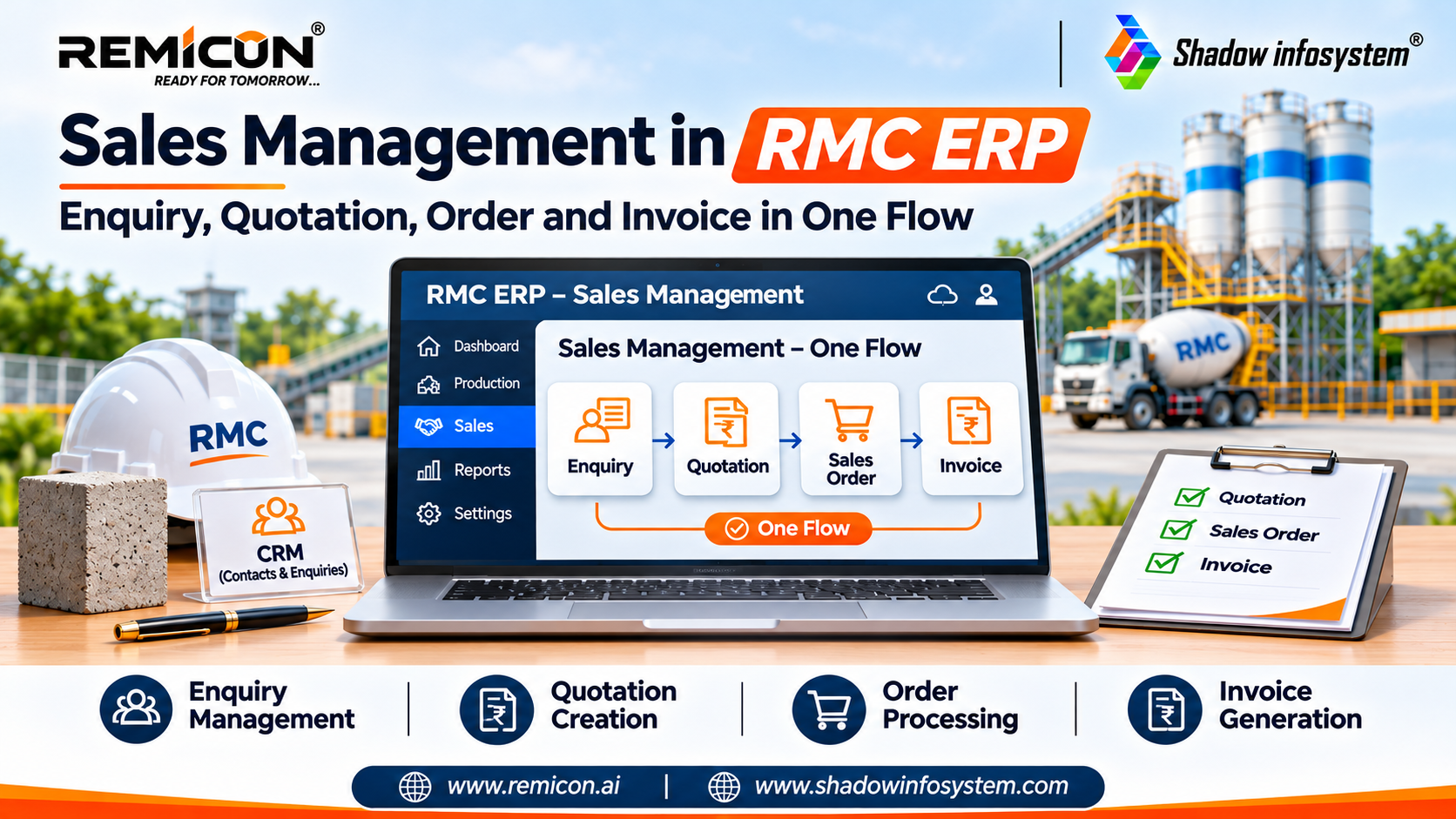
The management of sales within the RMC company entails a number of interrelated processes, including inquiries by the customers, quotations, confirmation of orders, delivery of goods, billing and collections. The information concerning various grades of concrete, quantities, prices, delivery points and terms of payment is critical at each step.
If such actions are coordinated using separate ledgers and spreadsheets, the sales team might be subjected to inaccurate quotations, missed payments, delays in invoicing and problems with tracking payments.
RMC sales management software helps bring these activities into a connected workflow. It gives sales, dispatch and accounts teams better visibility into customer information, confirmed orders, billing records and payment status.
REMICON by Shadow infosystem connects important RMC business operations, including customer management, sales order coordination, dispatch, billing and payment tracking. This helps businesses maintain organized records from the first customer enquiry to payment follow-up.
Why Does Sales Management Need a Connected Workflow in RMC Businesses?
An RMC sales transaction involves more than confirming the quantity of concrete required. Sales teams must record commercial and operational details accurately so that the plant, dispatch and accounts departments can work with the same information.
A typical customer order may include:
Customer name, contact details and GST information
Project name and delivery location
Required concrete grade, such as M20, M25 or M30
Required quantity in cubic metres
Agreed rate per cubic metre
Pumping and other additional charges
Expected supply date and schedule
Payment terms and approved credit limit
If such information is kept separately, then the same will have to be fed in again when preparing quotes, confirming orders and generating bills. This might cause some disparity between the price agreed upon, supplies made, and bills issued.
A connected RMC sales management software workflow helps maintain consistent customer and order records. It allows relevant teams to refer to the same information while coordinating quotations, confirmed orders, dispatch activities and financial transactions.
How Can RMC Businesses Manage Customer Enquiries and Requirements?
The sales process begins when a contractor, builder, infrastructure company or individual customer contacts the RMC plant with a concrete requirement.
Before preparing a quotation, the sales representative needs to understand the customer's project requirements. Recording these details properly helps avoid confusion when the enquiry moves towards order confirmation.
Important enquiry details include:
Customer and company information
Contact person and communication details
Project name and site location
Required concrete grade and estimated quantity
Expected supply schedule
Pumping or other additional requirements
Special instructions or project-specific conditions
Maintaining these details in organized customer records helps sales representatives review previous enquiries and understand customer requirements.
REMICON by Shadow infosystem includes a Customer Master & Accounts module that supports customer profiles, GST details, delivery sites, credit limits and outstanding balances. This gives sales and accounts teams a common reference for customer-related information.
How Should RMC Plants Prepare Grade-Wise Quotations?
Preparing an accurate quotation is an important part of RMC sales management. Concrete prices can vary according to grade, quantity, project location, transportation requirements and additional services.
For example, an RMC plant may receive enquiries for M20, M25 and M30 concrete from the same construction company. Each grade may have a different agreed rate per cubic metre. The quotation should clearly mention the applicable grade, quantity and price instead of using one general rate for the entire requirement.
What Details Should an RMC Quotation Include?
A structured quotation should clearly mention:
Customer and project details
Concrete grade and specifications
Quoted rate per cubic metre
Estimated quantity
Pump charges, wherever applicable
Transportation or other agreed charges
Applicable taxes
Payment terms
Quotation validity
Special commercial conditions
Why Should Pump Charges Be Recorded Separately?
Pump charges can affect the final order value and should be clearly mentioned in the commercial terms. Depending on the agreement, these charges may vary according to pumping requirements, site conditions, minimum usage or other agreed conditions.
For example, a quotation for M25 concrete may include a separate pumping charge. If this amount is not recorded properly, the sales and accounts teams may use different figures while confirming the order or preparing the invoice.
Quotation management for ready mix concrete should maintain a clear breakup of concrete rates and additional charges. This gives the customer a better understanding of the proposed amount and provides the sales team with a reference during order confirmation and billing.
How Can RMC Plants Convert Confirmed Quotations into Sales Orders?
Once a customer accepts the quotation, the next step is to confirm the sales order. This stage connects the commercial agreement with the operational requirements of the RMC plant.
The confirmed order should contain the approved concrete grade, quantity, price, delivery location, supply schedule and applicable additional charges. Any changes requested by the customer should also be recorded to maintain an accurate order history.
A concrete order management system helps RMC businesses maintain these details in an organized format and coordinate with production and dispatch teams.
Important Details to Maintain in an RMC Sales Order
REMICON connects sales orders with batching plant operations, helping businesses link customer requirements with production and dispatch activities. This reduces the need to maintain disconnected order records across departments.
What Is the Difference Between a Proforma Invoice and a Commercial Invoice in RMC?
Understanding the difference between a proforma invoice and a commercial invoice is important for RMC sales and accounts teams. Both documents communicate financial information, but they serve different purposes.
Key differences between a proforma invoice and a commercial invoice:
RMC businesses should follow applicable GST requirements when determining the timing and format of their final invoices. The term commercial invoice may be used differently by different businesses, so the relevant GST tax invoice requirements should remain the reference for domestic taxable supplies.
How Can RMC Plants Connect Sales Orders with Dispatch and Billing?
Billing accuracy depends on the connection between confirmed orders, actual dispatch quantities and customer-specific rates.
If dispatch records and accounts records are maintained separately, the finance team may need to collect information from multiple departments before preparing an invoice. This can delay billing and increase the risk of incorrect quantities or missed charges.
Sales order to invoice software helps connect commercial and financial records so teams can refer to the relevant order and dispatch information during billing.
A structured RMC billing workflow generally includes the following activities:
The sales team confirms the customer order and agreed rates.
The plant processes the confirmed requirement.
The dispatch team records the quantity supplied and relevant delivery details.
The billing team checks the order, dispatch records and applicable charges.
The final invoice is prepared with the required customer and tax details.
The payment record is updated against the customer account.
REMICON supports finance and billing activities through sales and purchase bills, payment tracking and financial reports. Shadow infosystem's RMC ERP also lists customer billing, GST invoicing, receivables and financial reporting among its finance and accounts capabilities.
This connected approach helps reduce repeated data entry and improves visibility into the relationship between sales, dispatch and billing.
How Do RMC Plants Manage Customer Credit Limits and Outstanding Payments?
Customer credit management is a major responsibility for RMC sales heads. Many RMC businesses supply concrete to contractors and construction companies under agreed credit terms. However, accepting new orders without reviewing previous outstanding payments can increase financial exposure.
How Do Customer Credit Limits Work?
A credit limit is the maximum outstanding amount a business allows a customer to maintain under the agreed credit arrangement.
For example, an RMC plant may approve a credit limit of ₹10 lakh for a customer. If the customer already has ₹8 lakh in outstanding payments, the sales team should review the available credit before confirming another large order.
A practical credit-control process includes:
Set customer-wise credit limits: Maintain an approved credit limit for each customer based on the business agreement.
Review outstanding balances: Check unpaid invoices before confirming additional orders.
Monitor payment ageing: Identify payments pending for different periods, such as 0–30, 31–60 and 61–90 days.
Record payment terms: Maintain agreed payment periods and conditions in customer records.
Control credit extensions: Route requests for higher limits or additional discounts through the appropriate approval process.
Coordinate with accounts: Ensure sales representatives have access to updated payment information before making commercial commitments.
REMICON's Customer Master & Accounts module supports customer credit limits and outstanding balance visibility. Its mobile approval capabilities also include customer credit limit extensions and site price discounts, allowing authorized users to review such requests.
Customer outstanding tracking gives sales and accounts teams better visibility into unpaid amounts and helps them prioritize payment follow-ups. It also supports more informed decisions when reviewing new orders from existing customers.
How Does REMICON by Shadow infosystem Support RMC Sales Management?
REMICON by Shadow infosystem connects customer records, production, dispatch, billing and payment information through a cloud-based RMC ERP platform.
Its Customer Master & Accounts module supports customer profiles, GST details, delivery sites, credit limits and outstanding balances. Sales orders can be connected with batching plant operations, while Dispatch & Logistics Control supports transit mixer assignments, delivery trips and digital challans.
The Finance & Billing module helps businesses maintain sales and purchase bills, payment records and financial reports.
Key capabilities relevant to sales and commercial operations include:
Customer Master & Accounts: Maintain customer profiles, GST details, delivery sites, credit limits and outstanding balances.
Production & Plant Batching: Connect sales orders with batching plant operations and maintain production records.
Dispatch & Logistics Control: Coordinate transit mixer assignments, delivery trips and digital challans.
Finance & Billing: Manage sales and purchase bills, payment tracking and financial reports.
Mobile Approvals: Support authorized approval of customer credit limit extensions and site price discounts.
Management Visibility: Review operational and financial information through connected dashboards and reports.
These capabilities help sales heads coordinate with plant, dispatch and accounts teams while maintaining better visibility into customer orders and financial activities.
Serving RMC Plants Across South India
REMICON by Shadow infosystem is serving RMC businesses across South India, including RMC plants in Bangalore, Chennai and Hyderabad. Its centralized ERP platform supports customer management, sales order coordination, dispatch, billing and payment tracking for ready mix concrete operations.
By connecting customer records with operational and financial information, REMICON helps RMC businesses maintain better visibility across their sales and order management activities.
Why Choose REMICON for RMC Sales and Billing Management?
Managing customer enquiries, quotations, orders, invoices and collections through separate systems can make it difficult to maintain consistent commercial records. RMC businesses need a connected process that supports coordination between sales, production, dispatch and accounts.
REMICON by Shadow infosystem offers:
Centralized customer and project records
Visibility into customer credit limits and outstanding balances
Sales order connection with batching plant operations
Dispatch coordination and digital challan records
GST invoicing and financial reporting capabilities
Mobile approvals for credit limit extensions and site price discounts
Cloud-based access and multi-plant management
With these capabilities, RMC sales management software can help sales heads maintain better control over commercial commitments, customer accounts and billing coordination.
REMICON by Shadow infosystem brings essential RMC business functions together, helping plant owners and sales teams manage customer relationships and financial activities with greater clarity.