
Concrete quality is one of the most important considerations in RMC operations. Batches sent to the job site must meet the required mix specifications and strength criteria. Proper management of mix design, raw-material testing, sampling, and cube testing can ensure consistent quality.
But tracking these processes through handwritten logs and separate spreadsheets can make it hard to ensure proper records are kept. Missing deadlines, delayed reports and missing sample data could impact quality control and the ability to track down past results.
Concrete quality control software helps RMC businesses organize quality-related activities through a centralized digital system. It connects mix design information, laboratory test results, cube test records and quality reports, giving plant managers and quality control teams better visibility into concrete quality.
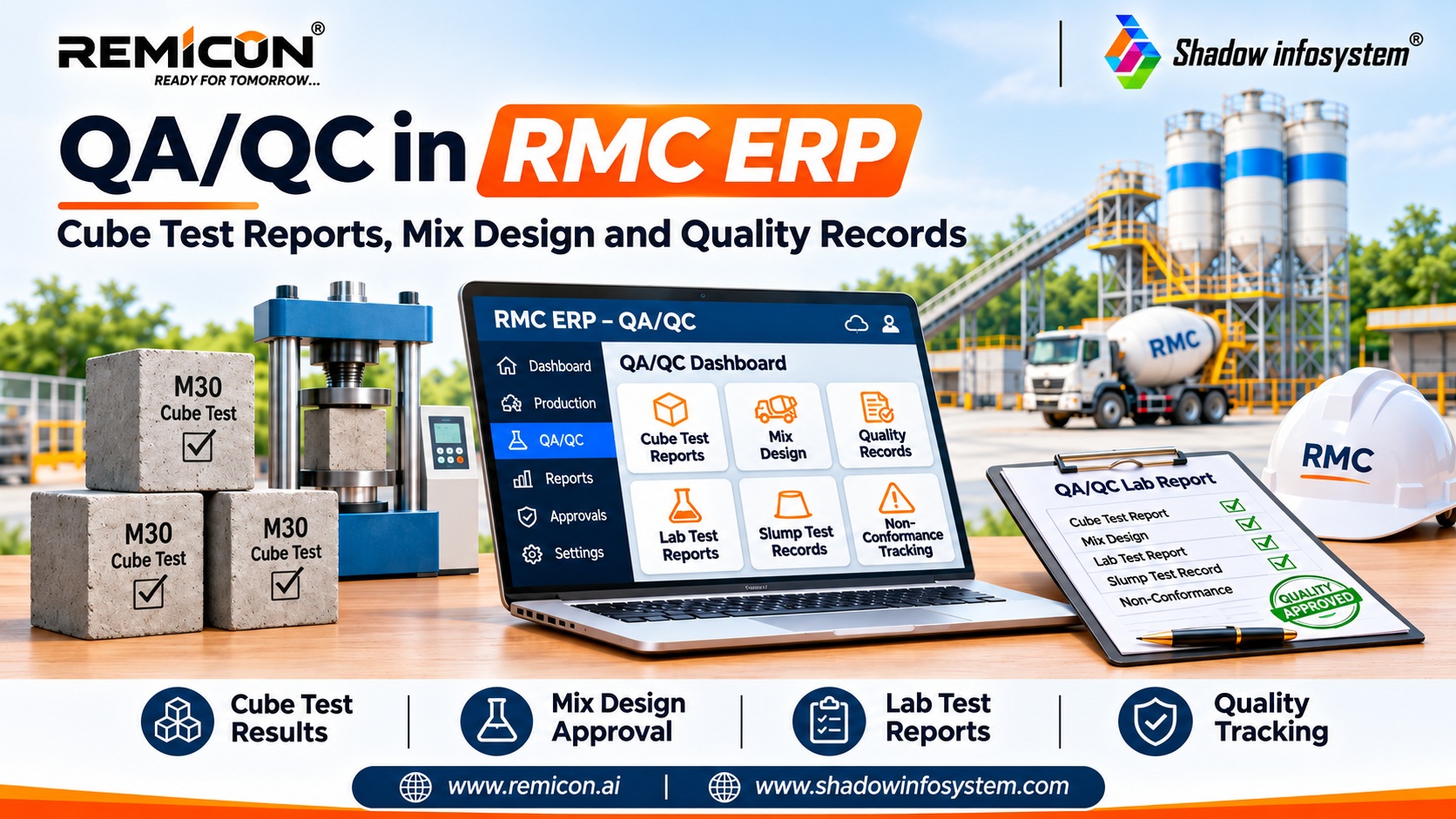
REMICON by Shadow infosystem is a cloud-based ERP solution developed for ready-mix concrete businesses. Its Quality Control (QC) module supports mix design approvals, lab test reports, cube test results, slump test records, quality audits and non-conformance tracking. It helps RMC teams maintain structured quality records alongside production and operational information.
Why Is Quality Control Important in RMC Operations?
The quality of concrete is influenced by many things, which include the characteristics of the raw materials, proportioning, batching process, water-to-cement ratio, transportation and handling. Any issue in the process affects concrete quality.
Without organized quality records, RMC plants may experience challenges such as:
Missed testing schedules: Teams may overlook important 7-day, 28-day or other scheduled cube testing dates.
Scattered laboratory records: Test results maintained in different registers can become difficult to retrieve.
Mix design inconsistencies: Using outdated or unapproved mix specifications can affect production quality.
Incomplete sample information: Missing sample identification and casting dates make result tracking difficult.
Delayed quality reporting: Manual report preparation increases administrative work.
Limited traceability: Connecting a test result with its production batch and customer delivery can become complicated.
A dedicated concrete quality control software system helps maintain consistent documentation and provides better visibility into quality-related activities throughout the production cycle.
Understanding Mix Design Management in RMC Plants
The mix design is used to establish the ratio of cement, aggregates, water, and additives for the attainment of the required concrete grade and properties.
In view of the various needs of construction, varying grades of concrete, exposure, workability, and strengths are used. Consequently, RMC plants need to keep accurate information regarding mix designs.
What Does Mix Design Management Include?
A structured mix design process generally involves:
Concrete grade and mix identification.
Cement and supplementary cementitious material proportions.
Fine and coarse aggregate quantities.
Water and admixture requirements.
Water-cement ratio.
Required workability.
Mix design approval and revision records.
Supporting laboratory test information.
REMICON includes Mix Design Management within its Production Management capabilities and Mix Design Approval within its Quality Control module.
This helps RMC teams maintain organized mix specifications and connect relevant mix information with production and quality records.
What Is a Cube Test Report?
A cube test report is a laboratory document that records the results of compressive strength testing on concrete cubes.
RMC companies collect concrete samples and cast them into molds for testing during production and delivery.
The resulting strength values help determine whether the concrete meets the specified strength requirements.
A typical cube test report contains:
Customer and project details.
Concrete grade.
Sample identification number.
Date and time of casting.
Date of testing.
Sample age in days.
Cube dimensions.
Individual cube weights, where recorded.
Maximum load at failure.
Calculated compressive strength in MPa or N/mm².
Average compressive strength.
Test observations and remarks.
How Does Cube Test Report Software Help?
A dedicated cube test report software solution helps maintain sample-wise testing information and organize laboratory results in a structured format.
Instead of searching through multiple registers, quality teams can access recorded test information, review historical results and maintain documentation for different concrete grades and construction projects.
REMICON's Quality Control module supports cube test results and lab test reports, helping RMC businesses maintain centralized quality documentation.
How Do RMC Plants Track 7-Day, 28-Day and Other Cube Testing Periods?
Cube testing requires proper scheduling because concrete strength develops over time. The 7-day and 28-day tests are commonly used testing stages, but RMC plants may also need to conduct tests at additional ages depending on project specifications, concrete requirements and applicable standards.
For this reason, 7-day, 28-day and more cube test tracking should cover all required testing periods rather than being restricted to two fixed dates.
1. Record Sample Details at the Time of Casting
Every sample should have a unique identification reference. The quality team records important information such as:
Sample ID or cube number.
Concrete grade.
Customer and construction site.
Casting date.
Production batch reference, where available.
Scheduled testing dates.
Accurate sample registration is important because all subsequent test results depend on correctly identifying the original sample.
2. Schedule 7-Day Cube Testing
The 7-day test provides an early indication of concrete strength development.
For example, if a sample is cast on 1 November, its 7-day test is generally scheduled for 8 November, subject to the applicable testing procedure and project requirements.
Quality teams should maintain the due date and update the result once testing is completed.
3. Schedule 28-Day Cube Testing
The 28-day test is a major reference point for evaluating concrete compressive strength against the specified grade requirements.
For the same sample cast on 1 November, the 28-day test is generally scheduled for 29 November.
Maintaining both testing schedules helps teams avoid missed laboratory activities and incomplete quality records.
4. Track Additional Testing Ages
Certain projects may require additional testing at different curing ages, such as 3, 14, 56 or 90 days. These requirements depend on project specifications, concrete performance requirements and the applicable testing standards.
A complete 7-day, 28-day and more cube test tracking process should accommodate these additional testing periods.
For example, a quality team may maintain separate schedules for early-age strength checks, standard testing stages and extended-age strength evaluation. Each sample should have its own testing dates and recorded results to maintain accurate documentation.
5. Use Reminders for Upcoming Tests
Automatic reminders can help quality teams prepare for upcoming testing activities and reduce the possibility of missed schedules.
A configured reminder workflow can be organized around:
Sample casting dates.
Upcoming 7-day test dates.
Upcoming 28-day test dates.
Additional scheduled testing ages.
Pending laboratory results.
Overdue test entries.
Results requiring review.
As the best cube test report software, REMICON provides smart alerts and centralized quality records. Specific cube-test reminder rules and notification triggers should be configured and confirmed during implementation according to the plant's requirements.
This helps teams maintain an organized testing schedule rather than depending entirely on manually checking registers.
Raw Material Testing and Quality Monitoring in RMC Plants
Concrete quality begins before the batching process. The properties of cement, sand, aggregates, water and admixtures can influence the strength, durability and workability of the final concrete.
Therefore, raw material testing in RMC plant Software operations plays an important role in maintaining consistent production quality.
Common quality checks include:
Cement Testing
Fineness.
Setting time.
Compressive strength.
Soundness.
Aggregate Testing
Sieve analysis and grading.
Specific gravity.
Water absorption.
Moisture content.
Aggregate impact and crushing value, where required.
Sand Testing
Sieve analysis.
Silt content.
Moisture content.
Specific gravity.
Admixture Testing
Compatibility with cement.
Specific gravity.
Performance and dosage verification.
The test frequency and acceptance requirements depend on applicable standards, material specifications and project requirements.
REMICON helps maintain quality-related records through its QC module, including lab test reports, quality audits and non-conformance tracking. This supports more organized documentation of quality activities.
How REMICON Simplifies Quality Management in RMC Plants
REMICON by Shadow infosystem brings quality-related records and production information into one connected ERP platform. Its Quality Control module helps RMC businesses organize important testing and approval activities.
Key capabilities include:
Mix Design Approval
Maintain mix design information and approval records for different concrete grades and production requirements.
Lab Test Reports
Maintain laboratory testing information and supporting quality documentation in a structured system.
Cube Test Results
Record compressive strength results and maintain sample-wise test information for quality monitoring.
Slump Test Records
Maintain slump test information to monitor concrete workability and related quality parameters.
Quality Audit Reports
Organize quality audit documentation and maintain records for internal quality reviews.
Non-Conformance Tracking
Record quality deviations and non-conformance information to support investigation and corrective action.
These features make RMC quality management software useful for connecting quality documentation with everyday plant operations.
Benefits of Concrete Quality Control Software for RMC Businesses
A centralized quality management system helps RMC businesses maintain better control over testing activities and technical records.
Important benefits include:
Organized Test Scheduling: Maintain sample casting dates and planned testing schedules.
Better Documentation: Keep cube test results, laboratory reports and mix design information in one system.
Improved Traceability: Maintain references to concrete grades, samples and related production information.
Faster Report Retrieval: Access previously recorded test information without searching through multiple registers.
Consistent Quality Monitoring: Review test results and quality records to identify deviations.
Better Team Coordination: Provide quality teams and plant management with access to relevant operational information.
With RMC quality management software, plant managers can maintain better visibility into testing activities and make informed decisions using recorded quality information.
Serving RMC Businesses Across South India
Construction and infrastructure activities across South India create growing quality management requirements for ready-mix concrete businesses.
REMICON by Shadow infosystem is already serving RMC businesses across South India, including RMC plants in Bangalore, Chennai and Hyderabad. Its cloud-based ERP platform helps these businesses manage mix design approvals, cube test results, laboratory reports, slump test records and quality documentation through a centralized system.
With integrated production and quality management capabilities, REMICON supports organized quality records alongside everyday RMC operations. Its multi-plant support also helps businesses maintain operational visibility across different plant locations.
Why Choose REMICON by Shadow infosystem for RMC Quality Management?
Managing concrete quality requires consistent testing, accurate documentation and proper control over mix specifications. When these activities are maintained through disconnected records, retrieving test information and monitoring quality performance can become difficult.
REMICON provides an industry-specific ERP platform that connects quality management with production, inventory, dispatch and other RMC business functions.
Its quality-related capabilities include:
Mix design management and approval.
Lab test reports.
Cube test result records.
Slump test records.
Quality audit reports.
Non-conformance tracking.
Centralized operational records.
Cloud-based access.
Multi-plant management.
Smart alerts and reporting.
By connecting quality documentation with plant operations, REMICON helps RMC businesses maintain structured records and improve visibility into their quality management processes.
Maintain Better Concrete Quality Records with REMICON
Consistent concrete quality requires more than testing individual samples. It requires proper coordination between mix design, raw material quality, sample collection, laboratory testing and result documentation.
REMICON by Shadow infosystem brings these activities into a centralized ERP platform, helping RMC businesses manage quality records alongside their everyday plant operations.
Connect with Shadow infosystem to understand how REMICON can support your plant's mix design, cube testing and quality management requirements.